
Here we feature some particularly special images that were made at CSV. We provide additional background about the images and citations to Astrobin pages.
The Orion Region by Ben Hakala:
This astrophotography tour de force is a four panel mosaic image which covers a field of view which includes the Orion constellation and associated nebulae. The image shows much of the interstellar nebulosity that is known as the “Orion Molecular Cloud”, including the famous “Barnard’s Loop”. There are over 250 deep sky objects in this image. This is one of the most heavily photographed areas of the night sky but usually with narrower fields, focusing on one of the many deep sky objects in the region. (https://app.astrobin.com/search?p=eJy72V%2BSWlFiq2rupGpkVJaYU5oKpFWNHYFkUmqeqpFBRmJ2Yk4iSNDIGUjmJpYkZ4RUFiCUOfr4wGXz83Iqg1MTi5IzPPNCMktyUosd81JcUouTizILSjLz84ohutISc4pTVc1d1AoS01NtDcFUcGYVkGlgAADIjy17&i=e5xki7)

The “DNA Nebula” by Tom Fleming:
This image was honored as the Astrobin “Image of the Day”. The “DNA Nebula” is a filamentary shock structure within the Monogem supernova remnant, located in Gemini near the Monoceros border. The Monogem SNR, or Monogem Ring, is an enormous supernova remnant in the constellation Monoceros with extensions into Gemini. It’s estimated age is 80,000 to 100,000 years, and it is about 1,000 light years away. The Monogem SNR spans nearly 25 degrees and represents one of the most diffuse supernova shells in the Milky Way. It was identified through x-ray observations in the 1980s and 1990s which revealed a vast, faint, circular x-ray shell. Optical emissions are discontinuous and consist of faint filaments scattered along the rim. These Ha/Oiii filaments mark the last visible shock structures in this very old, evolved SNR.
The image shown here is one of those filamentary regions. The intertwined, helix-like filaments are reminiscent of a “double helix”, and this structure has led to the name “DNA Nebula”. (https://app.astrobin.com/search?p=eJy7OaEktaLEVtXcSdXIqCwxpzQVSKsaOwLJkvxcVSODtJzU3My8dJCokTOQzE0sSc4IqSxAqHP08YHL5uflVAanJhYlZ3jmhWSW5KQWO%2BaluKQWJxdlFpRk5ucVQ3SlJeYUp6qau6gVJKan2hqCqeDMKiDTwAAAF%2BouFw%3D%3D&i=5zq25u)

The DNA Nebula. © Tom Fleming, 2026.
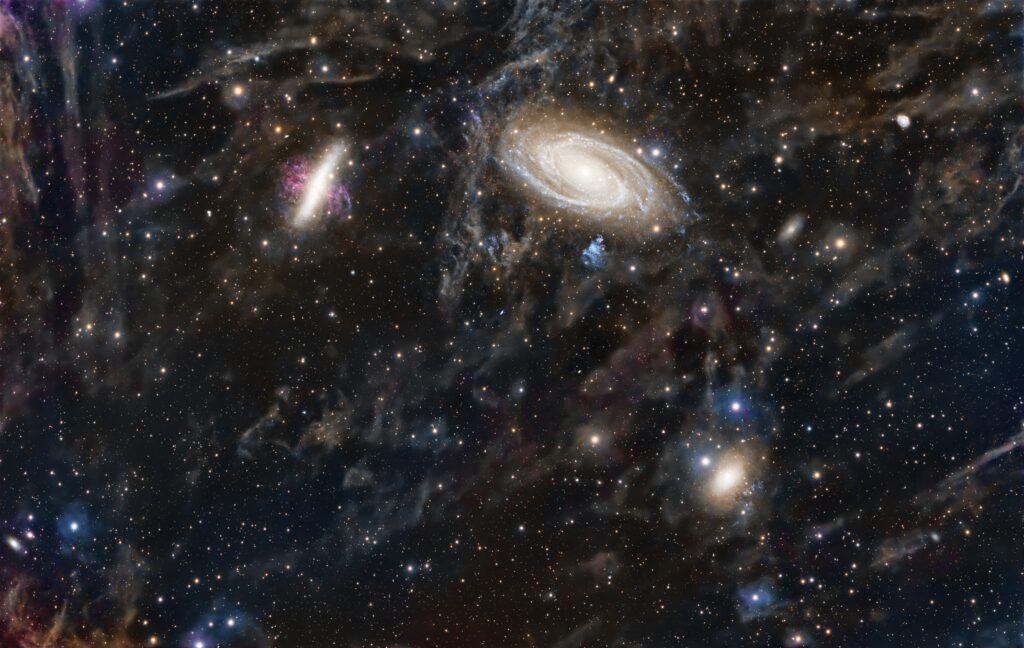
M81, M82 and NGC3077 by Mark Orvek:
This is another frequently imaged area of the sky. What’s special about this image is that Mark used very long integration times to bring out the Integrated Flux Nebulae (IFN) that can be seen between the deep sky objects in the image. To quote from Wikipedia (https://en.wikipedia.org/wiki/Integrated_Flux_Nebula), ‘The term (IFN) was coined by Steve Mandel, who defined them as “high galactic latitude nebulae that are illuminated not by a single star (as most nebulae in the plane of the galaxy are) but by the energy from the integrated flux of all the stars in the Milky Way. As a result, these nebulae are incredibly faint, taking hours of exposure to capture. These nebulae clouds, an important component of the interstellar medium, are composed of dust particles, hydrogen, carbon monoxide, and some other elements” ‘. (https://app.astrobin.com/search?p=eJy72VGSWlFiq2rupGpkVJaYU5oKpFWNHYFkflFZajaIZ%2BQMJHMTS5IzQioLEPKOPj5w2fy8nMrg1MSi5AzPvJDMkpzUYse8FJfU4uSizIKSzPy8YoiutMSc4lRVcxe1gsT0VFtDMBWcWQVkGhgAAKbKK30%3D&i=4vidrg)
M82 by Ken Toliver:
This remarkable higher magnification image of Messier 82 (the Cigar Galaxy) was taken by Ken using his 10″ Richy-Chretien telescope from his remote roll-off observatory at CSV. The image was awarded a Top Pick on Astrobin.
Messier 82 (also cataloged as NGC 3034), is one of the most fascinating and dramatic galaxies in the night sky. It’s a classic example of a starburst galaxy, located about 12 million light-years away in the constellation Ursa Major (the Great Bear).
It’s called the “Cigar Galaxy” because of its elongated, slender appearance when viewed edge-on from Earth (tilted roughly 80° to our line of sight), giving it a cigar-like shape rather than the more familiar spiral arms of galaxies like the Milky Way.
In visible light, thick dust lanes often obscure the core, but the galaxy shows dramatic filaments of glowing hydrogen gas and superwinds blasting material outward from the center (a “galactic superwind”). https://app.astrobin.com/i/zgpqdr?r=0
